
Why Great Boards Feel Different
By Darren Rawson
Darren Rawson is the chair of five private companies including AltaML and Chandos Construction. He’s a former CEO of three different private companies and has done business internationally for over 25 years in numerous industry sectors.
Imagine you are watching a championship sports team. You know they have a plan. But the reason they win isn't only because they follow the playbook and lines drawn on a clipboard.
They win because they have a feel for the game. They know when to speed up, when to slow down, and they trust each other. The pace is alive. Everything clicks. They move in sync making it look effortless. Watching it, you know they are in the zone.
Corporate boards of directors often operate as if their job is to follow the playbook. They spend hours rigorously on the "process" of working through a detailed board package, carefully following rules of order, and strict adherence to rules, protocols and formalities. While those things are important, they aren’t what actually makes a board great.
Governance is not done on a spreadsheet. The secret sauce of a high-performing board isn't found in the paperwork. It’s found in the cultural dynamics and the energy of the room.
High-performing boards tend to get three things right:
- Tone
- Rhythm
- Process
1. Tone: the emotional climate
The tone of a board is the underlying mood. You can feel it the moment you walk into the room or get on a call. Is it a room where people are defensive and guarded? Or is it a room where people feel safe to ask "dumb" questions?
If the tone is too formal or aggressive, people stop sharing the truth. They start "performing" instead of problem-solving. A board with a bad tone might have a perfect process on paper, but they will miss major risks because no one wanted to ruin the mood by bringing up a problem.
A great board understands it is more about achieving the organization’s purpose than following protocol.
A great board sets a tone of psychological safety. This doesn't mean everyone is nice all the time. It means people feel safe to disagree. When the tone is right, the board becomes a "think tank" rather than a courtroom.
Similar to a great sports team, you can often feel when the board has the right emotional climate and when it does not. The impact when it is right can be significant.
2. Rhythm: finding the beat
Have you ever been in a meeting that felt like it would never end? That’s a rhythm problem.
Process says: we must spend 20 minutes on every item on the agenda.
Rhythm says: this item is simple or we have alignment already, let’s handle it in five minutes and move on to talk about the massive shift in our industry.
Rhythm is about the flow of information and energy. A board with a good rhythm knows when to zoom in on a specific detail and when to zoom out to look at the big picture. If a board spends all its time looking at the past (e.g. last quarter’s numbers) and no time looking at the future (e.g. the winning strategy), the rhythm is likely off.
We advocate high-performing boards invest at least 50%-75% of their time forward-looking, as outlined in our HOFI framework. Great boards understand that it is more important to prioritize important conversations rather than simply follow the agenda. Often certain discussion emerges that merits more time than anticipated, and conversely some items don’t require as much time as the agenda states.
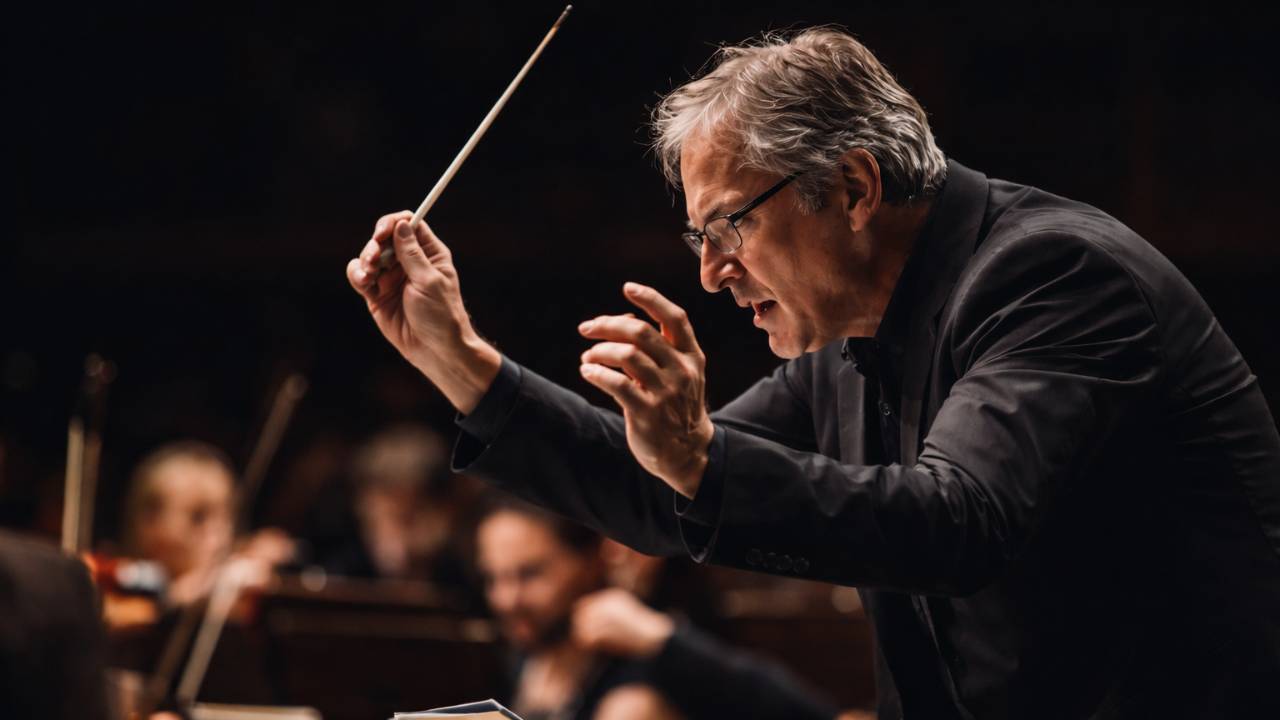
Think of it like music. If every note is played at the same volume and speed, it’s just noise. A great board chair acts like a conductor, making sure the conversation has hills and valleys. They create space for quiet reflection and moments for intense debate. {link to great chair article}
This is also what makes the conversation feel alive and invites directors to bring their full attention and experience to the table.
3. Presence: being "in the room"
In the age of laptops and smartphones, presence is a disappearing skill. You’ve likely seen a board member who is physically in their chair but mentally checking their email or thinking about their next meeting or flight.
Presence is about more than just paying attention; it’s about intent.
It’s the difference between hearing someone speak and actually listening to what they are trying to say. When board members are fully present, they pick up on the things that aren't being said and listen for hidden meaning. They notice the subtle anxiety from others when a certain topic comes up, or the excitement in a teammate's voice when discussing a new idea or engaging in constructive debate.
Without presence, the process becomes a check-the-box exercise. You can vote yes on a motion without being present, but you can’t provide wisdom without it. Wisdom requires you to bring your full self to the table. Your experience, your intuition, and your focus.
Why process Isn't enough
Don’t get me wrong: process is necessary. You need an agenda. You need minutes. You need policies. You need to follow the law. Process is the map, but the culture and the energy is the engine.
You can have the most expensive, detailed map in the world, but if your engine is dead, you aren't going anywhere. Many boards have "perfect" processes but are completely stuck because their tone is toxic, their rhythm is sluggish, and their members aren't present.
On the flip side, a board with great energy can often navigate a messy process. If they trust each other (tone), move effectively (rhythm), and stay focused (presence), they will find a way to make good decisions even if the agenda gets tossed out the window. Great directors run towards the fire rather than away from it. Like a great sports team, they are all in and looking to accomplish the same goal.
The diagram below shows that the relationship between process and performance is not linear. Beyond a certain point, adding more structure does not increase effectiveness. It can suppress it.
What lifts a board into the zone is not additional process. It is a collective lift that comes from getting process and energy right.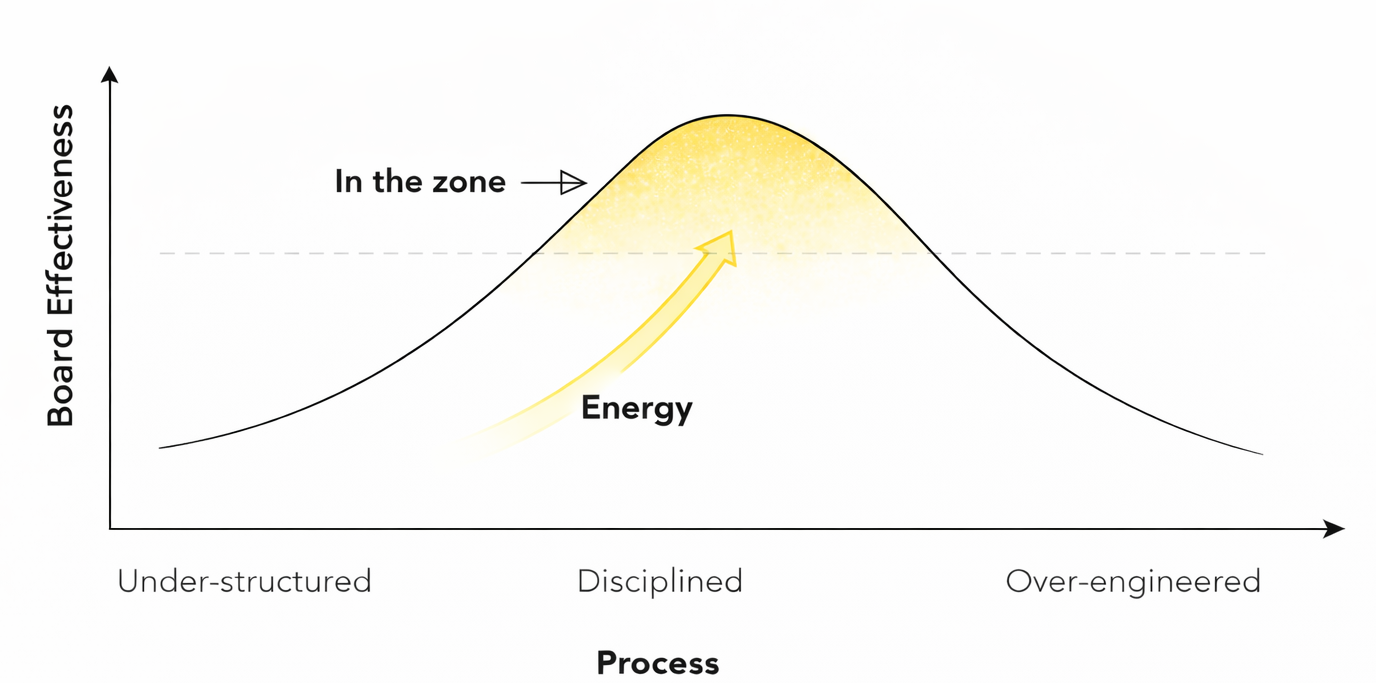
Putting it into practice
The best boards feel a lot like the best teams.
The next time you are in the boardroom, either as a director or from management, don't just look at the checklist. Look at how people are showing up.
- Check the tone: Is it safe to speak up? What does the energy feel like?
- Check the rhythm: Are we moving at the right speed for the task at hand?
- Check the presence: Is everyone truly here, or are they just occupying space?
Governance is a human activity, not a mechanical one. When you prioritize the energy of the board over the paperwork, you move from having a meeting to actually leading an organization and setting direction.
If you are going to have an active board, have a great one.
