
The True Cost of a Board

By Darren Rawson
Darren Rawson is an active chair and director on six private company boards. He’s a former CEO of three different private companies and has done business internationally for over 25 years in numerous industry sectors.
Have you ever calculated the cost of your board?
It is a humbling question to answer. Most organizations do not calculate the cost of their board. They either do not want to know the answer, which is most common, or they see it as a necessary cost that does not need to be questioned.
Every organization legally requires a board. However, there is a very wide range of options for how the board is structured and how the board carries out its work. These decisions come at a cost.
A board could be as simple as one or two shareholders (directors) meeting once a year for an hour. A board could also be dozens of directors and executives meeting 4 times per year for 2 days plus a strategic retreat plus numerous committees.
In an earlier article we explored how do you know if your board is adding value or not. While boards provide a necessary function with a fiduciary responsibility to the corporation, they should also be adding value.
Value should not be a gut instinct. Value should be measurable, and real value is the return generated relative to the cost. To understand that return, we first need to understand the cost.
Why Does This Matter?
One of the classic definitions of waste in lean manufacturing theory is anything a customer or shareholder is not willing to pay for.
Some forms of waste are unavoidable. A retail business, for example, needs inventory to generate sales. However, good retail businesses strive to optimize and minimize that investment to ensure the strongest possible return.
A board is also unavoidable. However, the design and cost of the board can and should be scrutinized and optimized.
Like an iceberg, where most of the mass sits below the waterline, the true cost of a board extends far beyond the visible direct costs of director fees and board expenses. It also includes indirect costs such as management time and lost opportunities, which can be much more significant.
Rarely do we calculate the time management invests in preparing for board meetings. We also rarely consider the cost of the actions and follow-up work created by board decisions and recommendations. Management typically accepts these activities as necessary and completes them without pushback.
Great organizations scrutinize their costs and ensure they are receiving value from their investments based on the weighted average cost of capital or an established threshold rate of return. Should a board not apply the same rigour to itself?
By understanding the true cost, high-performing boards can treat the board like any other critical investment and ensure the organization is receiving an appropriate return. This applies both to the overall cost of operating the board and to the incremental costs created by its actions and decisions.
What is the True Cost of a Board?
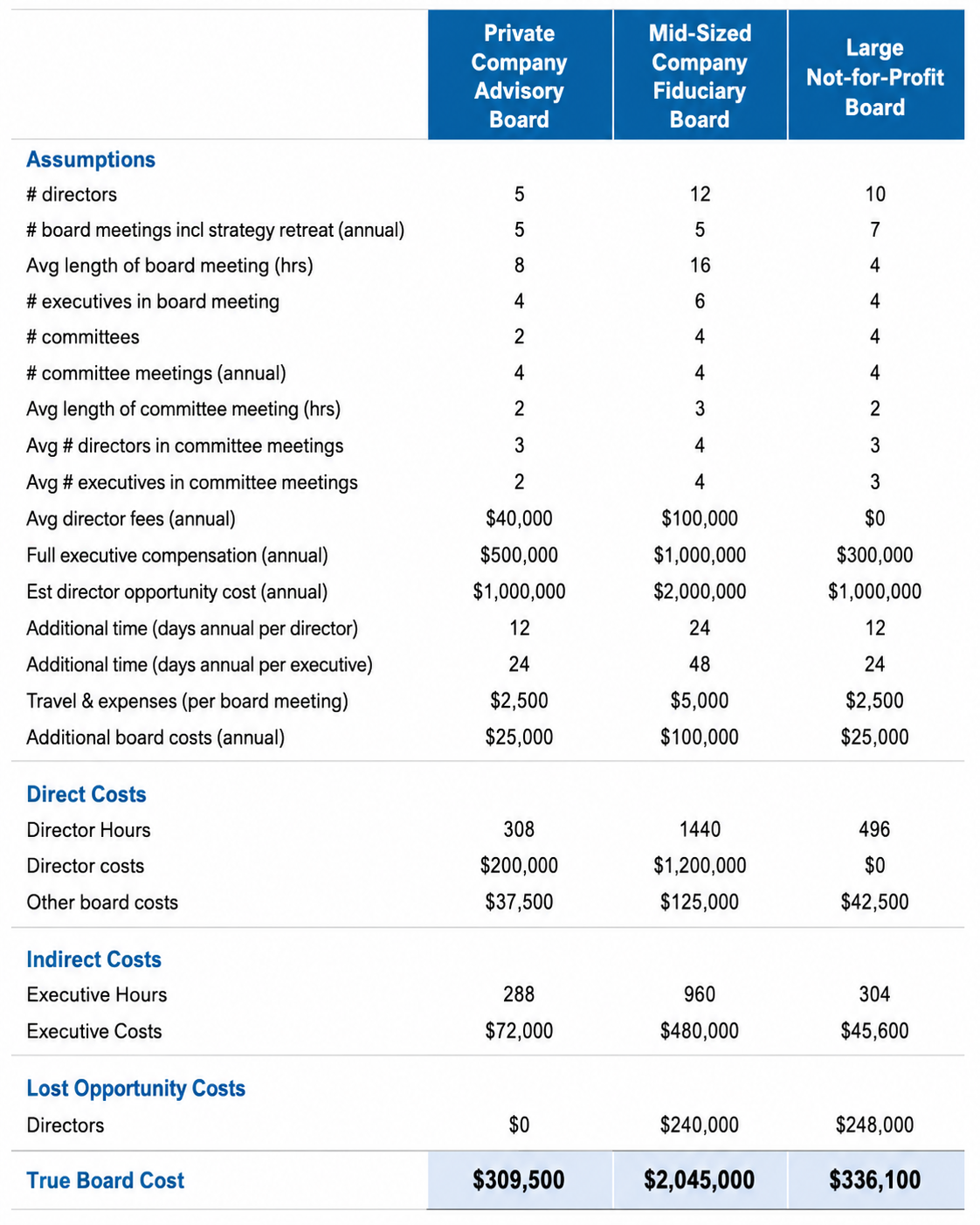
The true cost of a board can be estimated using a schedule considering direct and indirect costs and applying assumptions. The main components include:
Direct Costs:
- Director fees
- Meeting and travel expenses
Indirect Costs:
-
Executive and administrative time spent in board and committee meetings
-
Executive and administrative preparation time
-
Executive and administrative time spent on board-related follow-up activities
Lost Opportunity Costs:
- Opportunity cost for directors’ time in excess of director fees, in particular for volunteer directors or directors who spend significant additional time supporting the organization and the board.
Not Having a Board Does Not Mean Zero Cost
This is not to suggest that all board costs are avoidable.
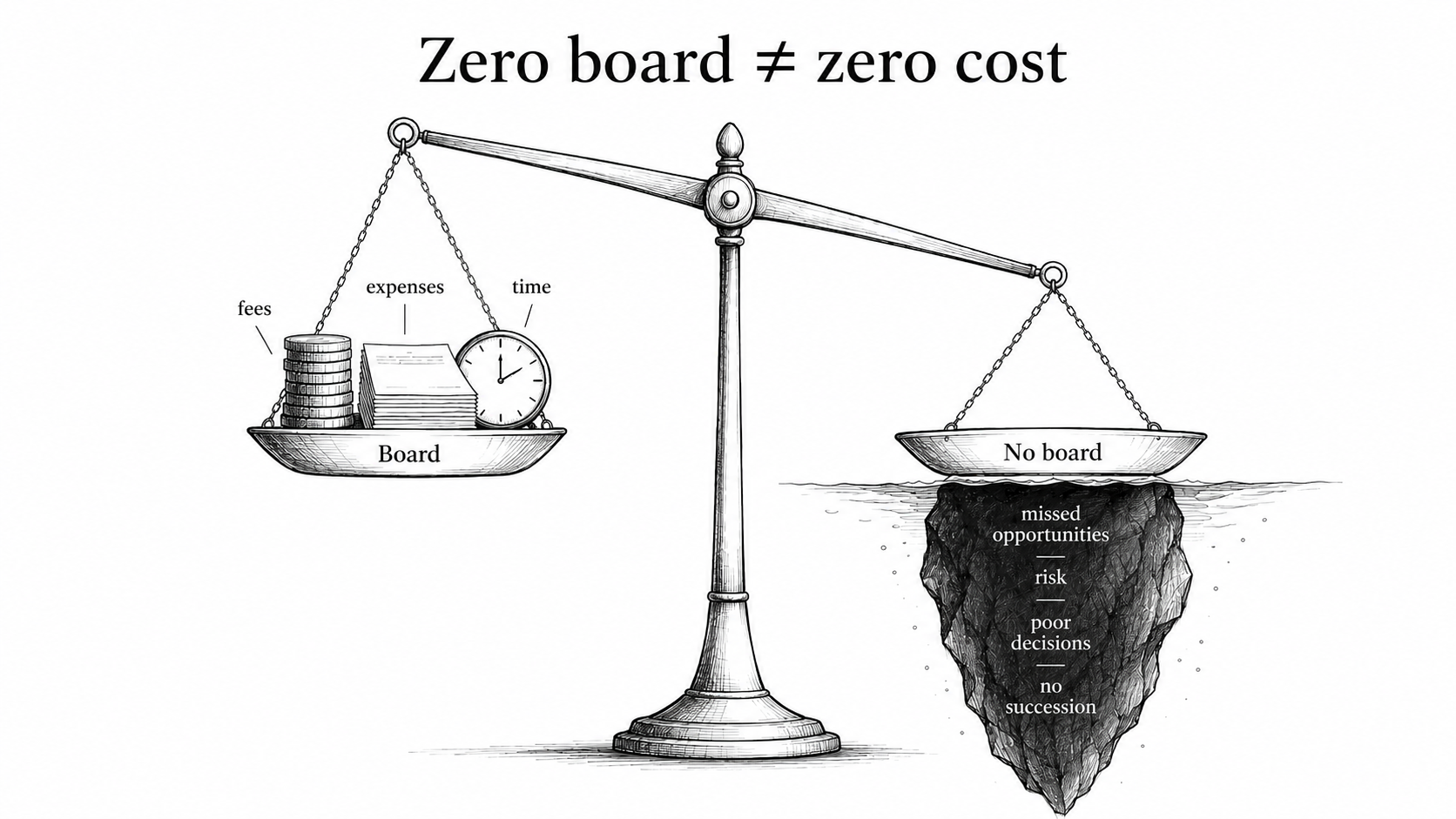
The cost of a board should not be compared with a scenario in which the cost is zero. It should be compared with the cost of not having an effective board.
That cost is harder to calculate and could be far greater.
Without an effective board, an organization may miss opportunities, make weaker strategic decisions, overlook emerging risks, delay difficult conversations or fail to act at critical moments. These costs may not appear in a budget, but they can have a significant impact on the organization’s performance and long-term value.
The real question is not whether a board costs money. It is whether the board generates enough value to justify that investment.
Conclusion
By no means are we suggesting a board is a pure cost with no value. High-performing boards can add immense value to a business, captured in a previous article: Top 10 Reasons to Have a Board.
The rigour and accountability created by a board, combined with a focus on choosing the right strategy, can materially improve an organization’s performance. Having the board present at critical inflection points and moments that matter can also be invaluable.
While the figures above are estimates based on generalized assumptions, they provide a useful proxy for understanding the cost burden of operating a board.
Calculating the true board cost is an important first step. Knowing this number can help the board assess whether:
- The board’s design and processes need to evolve.
- The burden placed on management is appropriate.
- The value generated through board and committee meetings is appropriate relative to the investment.
In most cases, this exercise should validate the value of the board. In other cases, it may reveal opportunities to reduce unnecessary work, improve the board’s design or increase the value it creates.
If you are going to have an active board, have an amazing one!
