
How to Do a CEO Assessment Well

By Mary Cameron
Mary is a former CEO and executive with experience in real estate, insurance, IT, and utilities. She was also a former Deputy Minister in two provinces. Mary is a full-time Director and Chair and has made a long-term commitment to Habitat for Humanity serving as past Chair of Habitat for Humanity International.
Many boards conduct a CEO assessment every year. Yet more often than not, very little changes afterwards, even when the process is supported by formal templates, surveys and sometimes external facilitators.
This is because most CEO assessments are treated as performance reviews. At the board level, however, that should not be their primary function.
The real purpose of a CEO assessment is to create alignment and motivate the CEO. It should not become a debate about compensation or whether the CEO is a four or a five.
Governance, at its best, is not about passing verdicts on individuals. It is about ensuring the board and CEO share a clear understanding of the company’s direction, what matters most, what the expectations are and which trade-offs might need to be made. When that clarity exists, performance can follow.
Developing the CEO is a team sport of the board. Evaluations should be designed to motivate and inspire the CEO. If they do not, it becomes much harder to develop the CEO and leadership team, and therefore much harder to achieve the best performance from the organization. In many cases it also reflects poorly on the board.
How often does the CEO or management team actually look forward to the assessment? It is likely rare, and that alone is a signal that the process may not be serving its intended purpose.
A well-designed assessment should create the conditions for the CEO to shine and provide a structured opportunity to acknowledge wins as well as identify areas for improvement. When done with this intention, it can become one of the most constructive governance conversations between the board and the CEO.
In a previous article, we compared assessments to how elite athletes approach performance. Athletes regularly put themselves through rigorous evaluation from coaches and trainers because even the smallest improvement can make the difference in their goals. The focus is not to receive a score, but to identify the few adjustments that will improve performance. Imagine if boards approached assessments with the same mindset.
How to Design the Assessment
At the board level, a CEO assessment should exist to answer a few fundamental questions:
- Are we aligned on what the key priorities are?
- Are we aligned on what success looks like?
- Do we fully understand the risks and the trade-offs required to achieve our goals?
- Are we aligned on whether the organization is positioned to deliver?
With any assessment, targets should be measurable, clear and focused on the critical few indicators that truly matter. Depending on the organization, these may span areas such as talent, quality, customer outcomes, growth initiatives, strategic transformation or sustainability priorities.
The objective is not to measure everything. It is to measure what matters.
If the scorecard itself is not aligned to the organization, no bonus structure will fix it. But if alignment is the foundation of the scorecard, most performance issues can be addressed early and clearly.
If the CEO assessment is primarily a compensation debate, it’s a sign that the board and CEO are misaligned on these fundamental questions. If unmet expectations come as a surprise during the assessment, it almost certainly means these questions were never clearly answered in the first place.
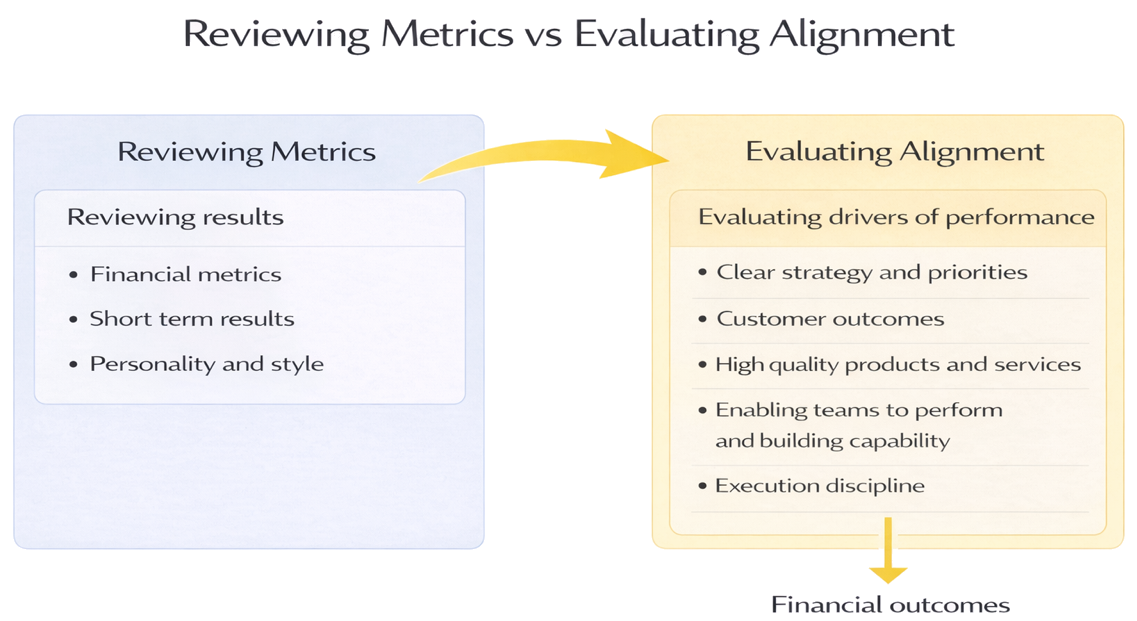
The illustration below shows the difference between a CEO assessment that focuses on reviewing results versus one that evaluates alignment with the key drivers of performance.
Where Most Boards Go Wrong
There are a few common traps where boards tend to go wrong with CEO assessments.
Boards assess the person, not the strategy. Assessments can tend to focus on individual performance such as communication style, isolated decisions, personality, or other leadership traits. While these behaviours matter, the CEO’s role is ultimately to ensure the strategy works and the organization can execute it. If strategy or execution is failing, those signals should be detected much earlier than the annual review.
They leave the difficult conversations too late. Alignment should be continuously calibrated, not addressed only once the formal review arrives. If directors are saving up concerns for the formal review, the process becomes reactive rather than constructive.
The scorecard has not been updated in years. Many boards reuse the same CEO scorecard year after year even as the environment changes. A scorecard that was appropriate during a growth phase may be completely misaligned during a transformation or turnaround.
They confuse operational metrics with leadership accountability. Boards sometimes rely on operational scorecards that belong to management. The CEO scorecard should focus on enterprise priorities rather than dozens of KPIs that operational teams monitor every day.
In Practice
A high quality CEO assessment is not a once-a-year event. It works best as part of a continuous cycle of goal setting, alignment and feedback throughout the year.
The first step is setting clear goals for the organization at the beginning of the year or cycle, and designing the scorecard with metrics to support those goals. This ensures the targets are clear, focused and aligned to the business. Ideally this is done collaboratively with the CEO.
The CEO scorecard should not be a long list of operational KPIs. Instead it should reflect the few drivers that determine whether the organization will succeed. Importantly, the metrics should be consistent across the organization, but accountability is filtered through the layers. It is to be expected that these would change somewhat every year.
Financial results tend to follow when strategy is clear, products and services are high quality, customer needs are being met, teams are capable, execution is disciplined and risks are being managed well.
A high quality assessment should therefore focus on these underlying drivers of performance. Does the organization have the leadership, talent and culture required to execute the strategy? Are capital and resources aligned with the priorities? Are early warning signs or risks being surfaced and addressed? Is the organization strengthening the capabilities it will need in the future?
The assessment itself should begin with self-reflection by the CEO. This gives the board insight into how the CEO views progress against priorities, where they see the greatest risks, and what support they believe the organization needs from the board. It also creates a more balanced discussion rather than one that feels one-sided.
Some boards also invite limited feedback from members of the leadership team on how the board is supporting management. This can help the board understand how its oversight, guidance and communication are experienced by management. Strong governance is ultimately a two-way relationship. At least every few years a wider survey of staff (some sort of 360) should be incorporated in the review process.
Lastly, because the organization evolves over time, the CEO scorecard should evolve as well. Major strategic shifts, leadership transitions or changes in the risk environment often require revisiting the scorecard to ensure it continues to reflect the right priorities.
After the Assessment
Once the assessment is complete, boards should resist the temptation to produce a long list of recommendations. Instead, identify two or three priorities that will make the greatest difference over the next year.
Keeping the list short increases the likelihood that real change is possible. If the list is too long, the intention to improve is there but it’s much harder to keep focus and follow through.
A small number of priorities, revisited regularly throughout the year, creates clarity and reinforces alignment between the board and CEO. When approached this way, the assessment becomes less about judging performance and more about helping the CEO succeed. Developing the CEO is ultimately a team effort of the board.
